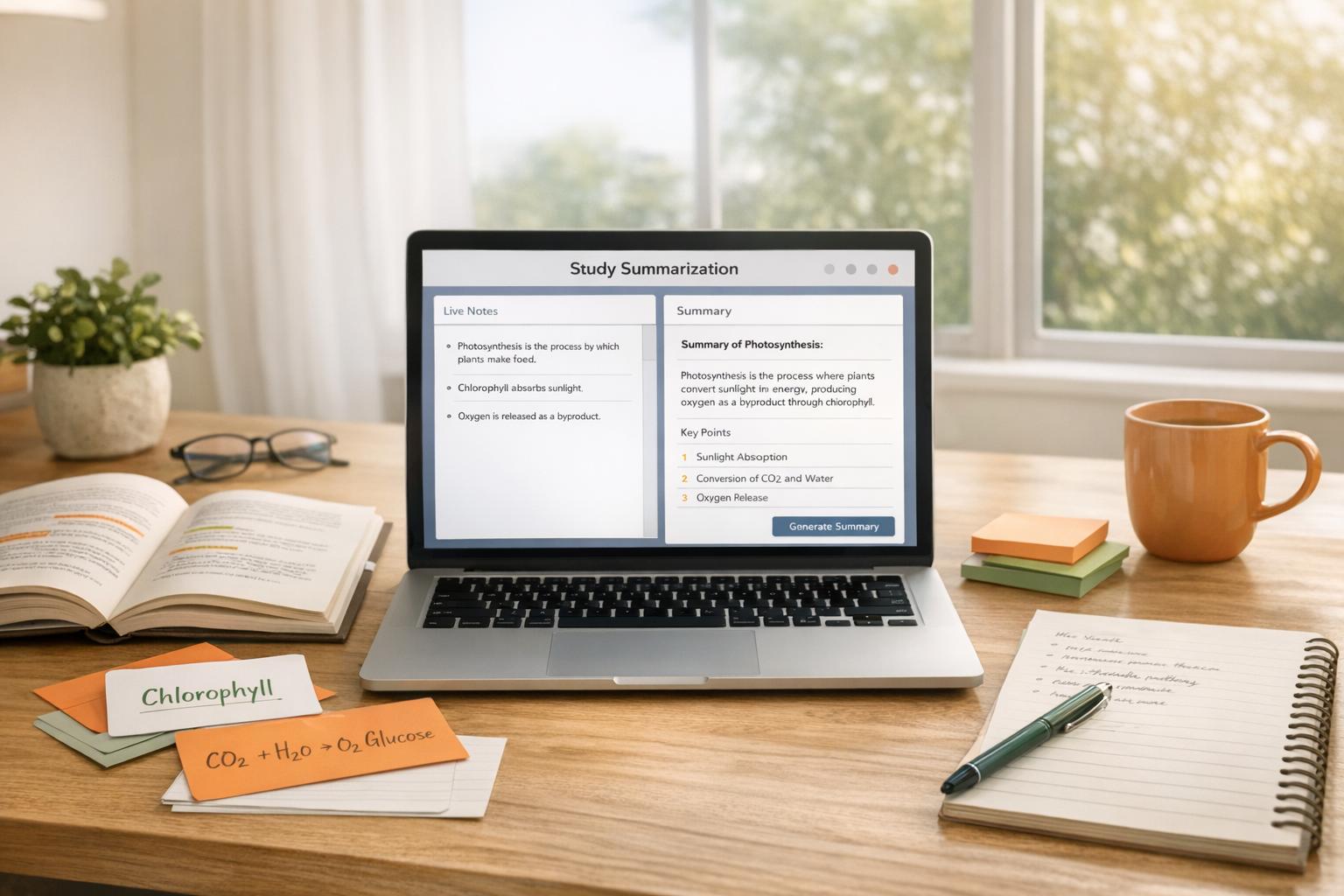
Real-time study summarisation uses AI to condense large amounts of information into concise summaries, saving time and improving learning efficiency. These tools can summarise textbooks, live lectures, and multimedia content while offering features like transcription, flashcards, and quizzes. With methods like extractive and abstractive summarisation, they simplify complex topics and support customisation for specific study goals. Tools like Testudy.io further enhance learning by turning summaries into interactive study aids, boosting retention and academic performance.
Key points:
- AI summarisation processes large texts or lectures in minutes.
- Supports multiple formats: PDFs, videos, handwritten notes, and more.
- Customisation options include summary length and format (e.g., bullet points, timelines).
- Integration with study tools like flashcards and quizzes improves retention.
- Research shows a 28% improvement in quiz performance and 40% less study time.
Real-time summarisation is reshaping how students learn by making studying faster, more focused, and interactive.
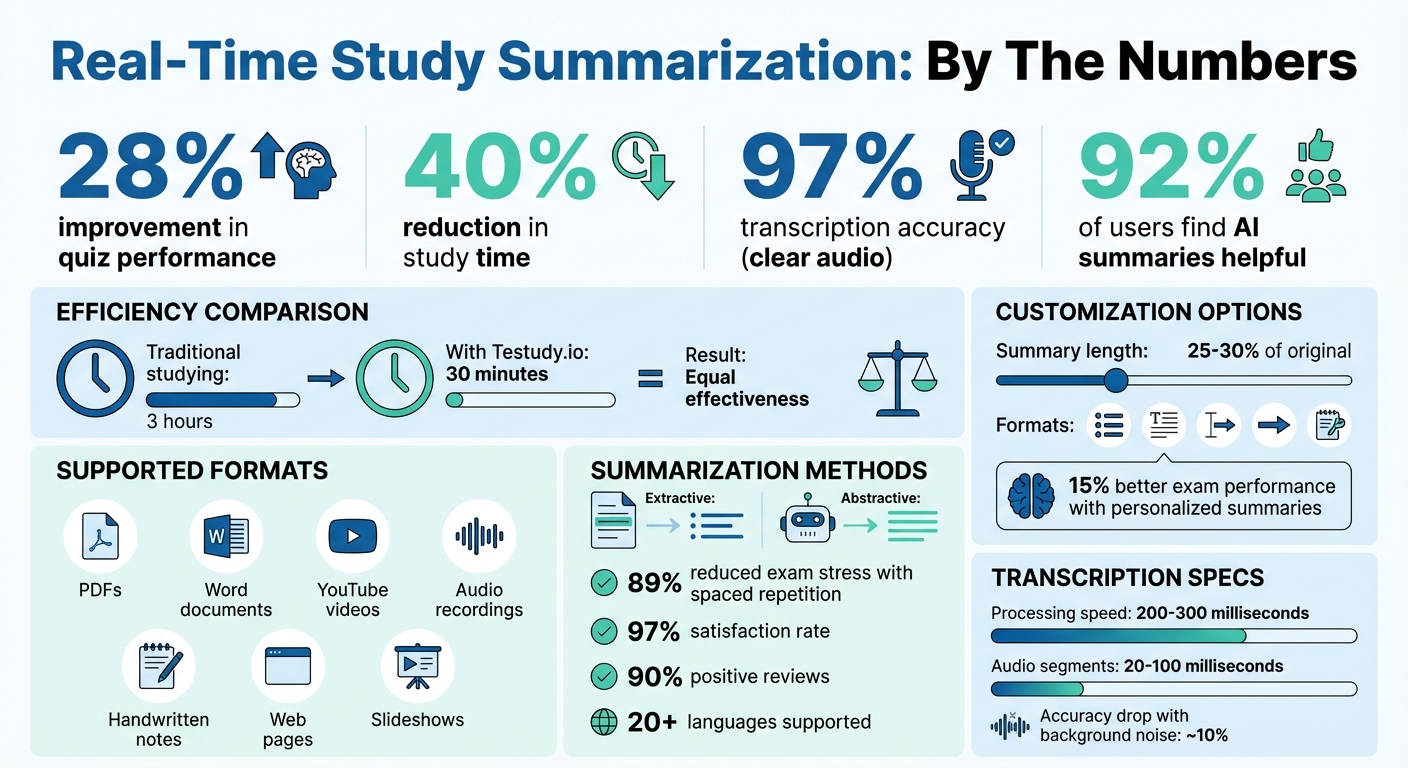
Real-Time Study Summarization Impact: Key Statistics and Benefits
How Real-Time Study Summarisation Works
Summarisation Techniques Explained
AI-driven summarisation operates using two main methods: extractive and abstractive techniques. Extractive summarisation works by identifying and selecting the most important sentences directly from the source text. Algorithms like LexRank or TextRank are often used to evaluate each sentence’s relevance to the central topic, assigning scores accordingly. On the other hand, abstractive summarisation takes a different approach, employing neural networks and large language models to create summaries that are shorter and read more like something a person might write. While extractive summaries stick to the original wording and are often more detailed, abstractive summaries offer a more natural flow, mimicking human-written notes.
Before the AI can summarise, it breaks the text into smaller units, such as words or phrases, removes unnecessary stopwords, and reduces words to their base forms. This cleaned-up text is then converted into mathematical vectors, which are used to rank and score sentences.
This foundational process also supports transcription capabilities for audio and video content.
Adding Transcription for Audio and Video
When it comes to multimedia, converting speech into text is an essential step for summarisation. Modern speech-to-text systems analyse audio in tiny segments, typically 20–100 milliseconds long, and can display text within just 200–300 milliseconds. The best systems boast over 97% accuracy when the audio is clear, though background noise can reduce this by about 10%.
Advanced tools can even identify different speakers and provide word-level timestamps, making it easier to navigate through the content. The quality of the audio plays a huge role here – a USB microphone costing around £55 can significantly outperform a standard laptop microphone by cutting down on background noise, which helps improve transcription accuracy.
Together, these processes create a seamless system that turns raw audio, video, or text into concise, study-ready summaries in real time.
What to Look for in Summarisation Tools
Multi-Format Support
The best summarisation tools can handle a wide range of materials, including PDFs, Word documents, slideshows, YouTube videos, web pages, audio recordings, and even handwritten notes. This versatility is invaluable for students, who often juggle multiple resources like lecture slides, textbook chapters, and supplementary videos. A tool that can process all these formats acts as a filter, helping you quickly sift through dense content before diving deeper into your studies.
Different types of content call for unique processing methods. For example, tools that summarise YouTube videos can include timestamps alongside the text, making it easier to navigate the content. Platforms designed for PDFs often preserve citations and complex formatting, which is crucial for academic work. If your studies rely heavily on videos, look for tools that summarise YouTube links directly. For academic papers, choose tools that handle technical notations and references with precision.
Customisable Summaries
Generic summaries often miss the mark when it comes to specific study goals. That’s why tools offering customisation options are so valuable. Features like adjustable summary length – often controlled by a percentage slider – allow you to condense material to around 25–30% of its original size. This keeps the essential context intact while saving you time. Additionally, the ability to switch between formats, such as bullet points for quick revision or paragraphs for understanding complex arguments, can make a big difference.
Advanced platforms go even further by offering specialised styles. For instance, a "Timeline" format is ideal for chronological events, "Key Note" provides structured overviews, and "Easy Note" simplifies scanning for key points. Research shows that students who personalise AI-generated summaries perform 15% better on exams. Custom instructions, such as "highlight exam-relevant concepts" or "retain all technical terms", can turn a basic summary into a highly targeted study aid. This level of personalisation sets the foundation for more interactive learning.
Study Tool Integration
Customised summaries naturally lend themselves to integration with study tools. For example, Testudy.io can transform summaries into multilingual quizzes and flashcards instantly. This kind of integration is crucial because active engagement, like testing yourself, significantly improves long-term retention.
A 2023 study from Stanford found that using AI summarisation tools boosted quiz scores by 28% and cut total study time by about 40%. Features like exporting flashcards to spaced repetition apps, generating practice questions, or creating mind maps directly from summaries turn your notes into dynamic study sessions. Tools that include citation options and video timestamps also help you cross-check information with the original source, maintaining academic accuracy and integrity.
Using Real-Time Summaries with Testudy.io
How to Generate Quizzes and Flashcards
With Testudy.io, creating interactive study aids like quizzes and flashcards is a breeze. Simply upload your materials – whether they’re text files, PDFs, lecture notes, or even screenshots – and let the platform do the heavy lifting. The AI scans your content, picks out key concepts, and generates question-and-answer pairs in just seconds.
Once generated, you can tweak the output to suit your needs. Adjust the difficulty, edit questions, or even add your own. If you’re studying online, the Chrome extension makes it even easier. Highlight text or take screenshots while browsing, and convert them into flashcards with just one click. This feature is especially handy for summarising YouTube lectures or web articles on the go.
Want to get your brain in gear before diving into study mode? Use Testudy.io to create a quick quiz. It’s a great way to sharpen focus and improve retention. Medical student Whitney Phillips shares her experience:
Even when I don’t feel like opening books, I can just create tests and learn 90% of my material in a less boring way.
These tools are designed to make studying not just efficient but also more engaging.
Benefits for Students
Testudy.io goes beyond just creating flashcards; it builds a smarter way to study. By incorporating active recall and spaced repetition, the platform helps cement information in your long-term memory. Plus, its adaptive learning technology analyses your quiz performance and tailors future questions to target your weaker areas.
And it’s a massive time-saver. Thirty minutes with Testudy.io is said to be as effective as three hours of traditional studying. The numbers back it up too, with a 97% satisfaction rate and 90% positive reviews. Law student Sophie Moore puts it best:
If Testudy existed when I started my degree, my GPA would be a lot higher. Honestly, it saves my grades.
The platform is also accessible to a global audience, supporting over 20 languages, including English, German, Spanish, and Chinese. Whether you’re a student tackling complex subjects or just looking for a smarter way to study, Testudy.io has you covered.
sbb-itb-3165b23
Best Practices for Real-Time Study Summarisation
Preparing Your Study Materials
Start by reviewing your syllabus to understand how topics are interconnected. This gives you a clear picture of the overall structure of your subject. Skim through chapter headings and lecture notes to familiarise yourself with the material. Before diving into summarisation, carefully read the text to pinpoint the main topic, key arguments, and overall structure.
Choose the right tool for your source material. For example, use specialised PDF tools for textbooks and web-based AI tools for articles or lecture notes. Ensure your prompts are clear and specific to get the most relevant summaries.
You can also create a "Magic Spreadsheet" system using Google Sheets. List all the topics in your subject, track when you generate summaries, and use colour coding to indicate your confidence level in each area. This visual tracker helps you identify knowledge gaps well before exam season.
Once your materials are ready, combine them with interactive tools to enhance your study process.
Combining Tools for Better Results
Incorporate AI-generated summaries into your study routine. After generating a summary, turn it into flashcards or quizzes right away. Studies show that testing yourself even once is more effective for retention than rereading a chapter four times. Platforms like Testudy.io can help with this – upload your summary, generate quizzes, and shift from passive reading to active recall.
Try the Cornell method: let the AI fill in the ‘Summary’ section while you create your own questions in the ‘Cues’ section. This method blends the efficiency of AI with the cognitive benefits of writing your own prompts.
To simplify complex ideas, use the Feynman Technique. As physicist Richard Feynman famously said:
The first principle is that you must not fool yourself and you are the easiest person to fool.
Regularly review your summaries using spaced repetition to fight the forgetting curve and lock information into your long-term memory. In fact, 89% of students reported reduced exam stress when they used tools that combine notes with spaced repetition.
Finally, always review and revise your summaries to ensure they are accurate and complete.
Reviewing and Refining Summaries
Always cross-check AI-generated summaries with the original sources, especially for complex topics. Some tools may copy key phrases without fully synthesising the information. Confirm that citations and data points are accurate and present in the original document.
If the first summary feels too vague or overly detailed, refine it using iterative prompting. For example, ask follow-up questions like, "Can you explain the connection between [Concept A] and [Concept B] in simpler terms?" Many tools include chat features that allow you to dig deeper into unclear sections.
Try summarising from memory using a closed-book method, then compare your version with the original source. This technique forces your brain to work harder, improving retention. As Dr Ali Abdaal explains:
The harder that your brain has to work to retrieve information, the more likely that that information will be encoded.
Finally, be on the lookout for inaccuracies or "hallucinations" in AI summaries. If something seems off or contradicts what you’ve learned in lectures, double-check it. This step ensures your summaries are reliable, tying together preparation, integration, and refinement into a seamless study process.
The 8 Best AI-Powered Studying Apps – Free & Powerful 💡
Conclusion
Real-time study summarisation is changing the way students tackle their coursework. These tools can cut study time by as much as 40% while improving quiz scores by 28%.
The real magic happens when speed is combined with active learning. Turning summaries into flashcards or quizzes on the spot moves you from simply reading to actively recalling information. Tools like Testudy.io make this process effortless – just upload your summary, create quizzes in over 20 languages, and start testing yourself immediately.
As we’ve seen, AI can be a fantastic study companion when paired with critical thinking and personal revision. It’s important to double-check technical details, add your own notes, and ensure citations align with original sources. As Empowerly explains:
AI isn’t doing the work for you; it’s helping your mind work smarter.
Whether you’re preparing for GCSEs, A-Levels, or university exams, combining real-time summarisation with active recall creates a highly effective study routine. Start with well-organised materials, choose the right tools for your needs, and refine your summaries through practice. With 92% of users reporting AI summaries as helpful when integrated into an active learning approach, platforms like Testudy.io can help you study more efficiently and reclaim precious time.
FAQs
What is the difference between extractive and abstractive summarisation?
Extractive summarisation works by picking out key sentences or phrases directly from the original text, keeping the wording exactly as it is. This ensures precision but can sometimes lead to summaries that feel disjointed or overly formal, since they mirror the style of the source material.
Abstractive summarisation takes a different approach by rephrasing or combining information to create new sentences, presenting the main ideas in a way that feels more natural and conversational. While this method produces smoother, more readable summaries, it demands more computational power and occasionally risks introducing inaccuracies.
Both methods are incredibly useful for creating real-time study summaries. For example, tools like Testudy.io can employ extractive techniques for quick, straightforward highlights or use abstractive models to generate personalised, easy-to-read notes – making studying a much more efficient process.
What are the advantages of combining summaries with study tools?
Integrating AI-generated summaries with study tools can greatly benefit students. By condensing long and complex materials into concise, easy-to-understand notes, these summaries help focus on the key concepts, making it simpler to grasp and remember information during study sessions.
When paired with platforms like Testudy.io, these summaries become even more powerful. They can be turned into personalised quizzes and flashcards, available in over 20 languages. This adaptability caters to individual learning preferences and boosts exam preparation. The combination of active recall techniques and multilingual options ensures support for a wide range of learners.
Moreover, linking summaries with organisational tools like task managers or calendars helps students stay on top of their schedules. This added structure reduces stress, sharpens focus, and makes studying more productive. It’s a smart way to optimise learning and achieve better results.
How can I make sure AI-generated summaries are accurate?
To make sure AI-generated summaries hit the mark, start by thoroughly examining the source material. Pinpoint the main ideas, supporting details, and any crucial figures, dates, or references. Giving the AI clear instructions – like specifying bullet points or brief summaries – can help produce results that are both relevant and precise.
After the AI generates the summary, take the time to verify its accuracy. Check all claims, statistics, and quotes against the original content. Pay special attention to numerical data and ensure any references or citations are correctly attributed. If you spot errors, tweak the AI prompt or make the necessary corrections yourself.
For an extra layer of accuracy, think about transforming your verified summaries into interactive tools. Platforms like Testudy.io let you create quizzes or flashcards based on the content. This not only strengthens your grasp of the material but also ensures the summary is reliable and ready for studying.