
Want to boost your learning? Start by getting enough sleep. Research shows that sleep is critical for memory consolidation – the process your brain uses to store and organise new information. Skipping sleep can reduce your ability to learn by up to 40%, making it harder to focus, retain knowledge, and solve problems.
Key takeaways:
- Sleep strengthens memory by transferring information from short-term to long-term storage.
- Teenagers need 8–10 hours of sleep, while adults should aim for at least 7 hours.
- Even partial sleep loss (3–6.5 hours) can harm memory as much as missing an entire night.
- Sleep stages like REM and Slow-Wave Sleep (SWS) play specific roles in organising and stabilising memories.
Simple tips to improve learning through sleep:
- Maintain a consistent sleep schedule.
- Avoid cramming; study earlier and pair it with proper rest.
- Create a sleep-friendly environment (cool, dark, and quiet).
Prioritising sleep isn’t just about feeling rested – it’s about helping your brain work smarter, not harder.
Hacking your memory — with sleep | Sleeping with Science, a TED series

The Problem: Sleep Deprivation Harms Learning
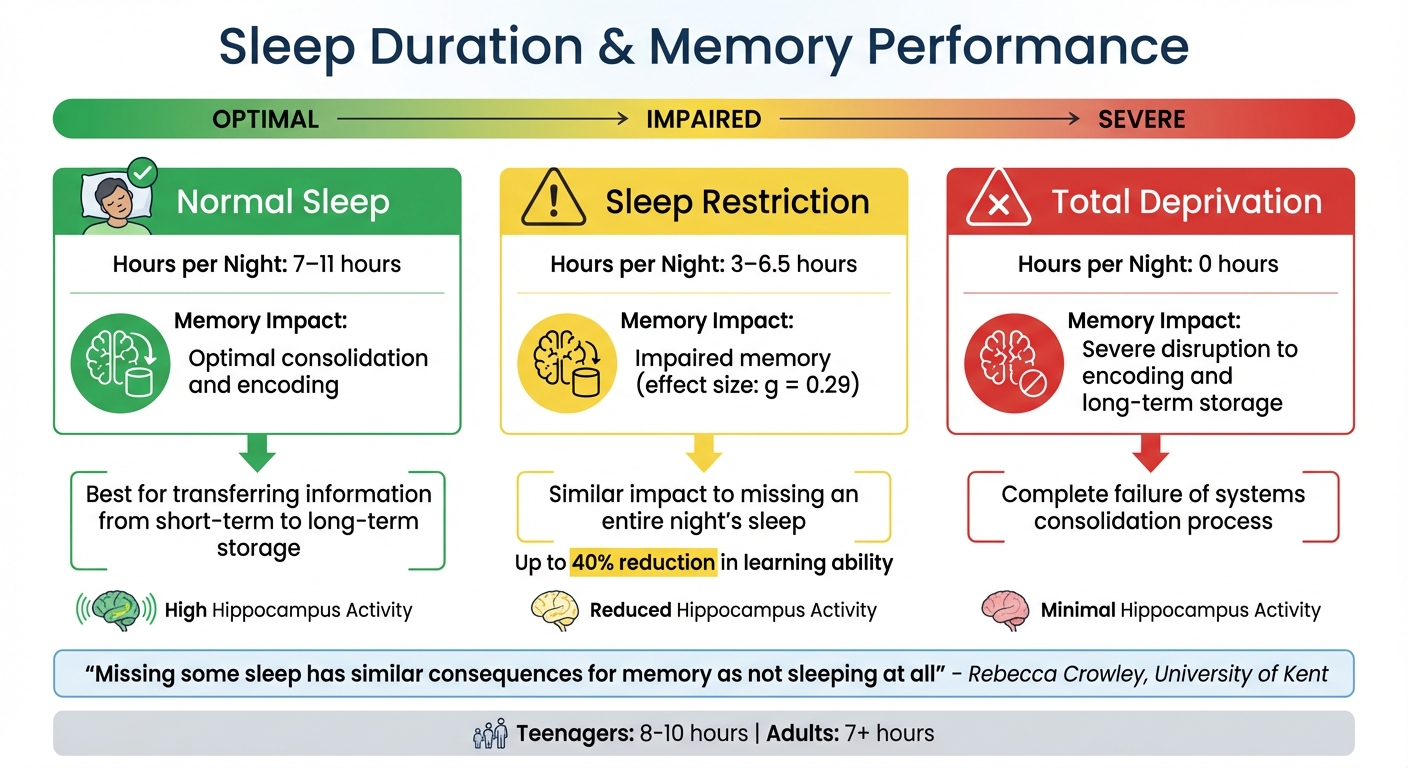
How Sleep Duration Affects Memory Formation and Learning Performance
Around half of teenagers don’t get enough sleep. This isn’t just about feeling groggy – it’s about how sleep deprivation disrupts the brain’s ability to learn and retain information.
How Sleep Loss Affects Thinking
When you don’t get enough sleep, your brain struggles to absorb new information effectively. The ability to create new memories is particularly sensitive to sleep deprivation, with both total and partial sleep loss causing long-term issues. The hippocampus, the part of the brain responsible for temporarily storing memories, becomes less active when you’re sleep-deprived, making it harder to retain new material.
Sleep deprivation also affects your ability to focus on what’s important. This can make concentrating during lessons or while reading much harder. Problem-solving and understanding complex ideas also suffer – students who don’t get enough sleep are less likely to identify patterns or come up with creative solutions to difficult problems. These effects don’t just hinder immediate learning; they also interfere with forming lasting memories.
Damage to Long-Term Memory
What’s even more concerning is that getting just 3 to 6.5 hours of sleep can harm memory formation as much as skipping an entire night’s sleep. Research highlights that this level of sleep restriction significantly disrupts memory processes (effect size: Hedges’ g = 0.29).
"Missing some sleep has similar consequences for memory as not sleeping at all."
– Rebecca Crowley, Researcher, University of Kent
Without enough sleep, the brain can’t complete "systems consolidation" – the process where memories move from temporary storage in the hippocampus to long-term networks in the cortex. Sleep-deprived brains fail to produce the signals needed for this transfer, and even one night of recovery sleep might not fully fix the damage. This leaves memories fragile and prone to being forgotten, making proper sleep essential for locking in new knowledge.
Academic Consequences for Students
These cognitive setbacks have a direct impact on academic success. One study on medical students found that sleep habits during the pre-exam period were the strongest predictor of final grades. Students who sacrifice sleep to study end up working against themselves because their brains can’t consolidate new information without adequate rest.
Sleep deprivation also makes it harder to recall information in the correct order. You might remember individual facts but struggle to piece them together logically – a major problem for subjects requiring step-by-step reasoning. On top of this, sleep-deprived students face heightened stress levels, which can make managing academic pressures and deadlines even more challenging.
| Sleep Condition | Hours per Night | Impact on Memory Formation |
|---|---|---|
| Normal Sleep | 7–11 hours | Best for consolidating and encoding new information |
| Sleep Restriction | 3–6.5 hours | Impaired memory (g = 0.29); similar to missing a full night |
| Total Deprivation | 0 hours | Severe disruption to encoding and long-term memory storage |
The Science: How Sleep Strengthens Memory
Getting proper sleep doesn’t just help you feel rested – it actively works behind the scenes to process and strengthen what you’ve learned, turning new information into solid, long-lasting memories.
Sleep Stages and Learning
Your night’s sleep is made up of 4–5 cycles, each lasting about 90–110 minutes. Within these cycles, your brain moves through different stages, and each one plays a specific role in organising and consolidating memories.
- Stage 2 NREM sleep: This stage takes up roughly 45% of your sleep and is characterised by short bursts of brain activity called sleep spindles. These spindles are crucial for locking in both procedural memories (like mastering a skill) and declarative memories (like recalling facts or dates).
- Slow-Wave Sleep (SWS): Also known as Stage 3, this phase makes up about 25% of your sleep and features slow delta waves. Here, your brain transfers memories from short-term to long-term storage.
- REM sleep: Another 25% of the night is spent in this stage, marked by rapid eye movements and heightened brain activity. REM sleep stabilises memories reorganised during SWS and is especially important for emotional memories and connecting different pieces of information.
| Sleep Stage | Key Brain Activity | Primary Memory Function |
|---|---|---|
| Stage 2 NREM | Sleep Spindles, K-complexes | Consolidation of procedural and declarative memories |
| Stage 3 (SWS) | Slow Oscillations, Sharp-wave Ripples | Transfers memory from hippocampus to neocortex |
| REM | Theta Waves (5–8 Hz) | Emotional tagging, integration, and stabilisation |
"During SWS, system consolidation promotes the re-activation and redistribution of select memory traces for long-term storage, whereas ensuing REM sleep might act to stabilise the transformed memories by enabling undisturbed synaptic consolidation."
– Nature Reviews Neuroscience
Together, these stages work to refine and strengthen your memories, ensuring they’re not only stored but also more structured and useful.
Strengthening Brain Connections During Sleep
During SWS, the brain essentially replays what it learned earlier in the day. This replay strengthens cortical connections, making memories more stable and less reliant on the hippocampus.
Three key brain rhythms coordinate this process:
- Slow oscillations (less than 1 Hz) from the cortex,
- Sleep spindles (12–16 Hz) that encourage synaptic changes, and
- Sharp-wave ripples (80–120 Hz) from the hippocampus, which help reactivate memory traces.
This process doesn’t just preserve what you’ve learned – it refines it, helping you uncover patterns or insights you might not have noticed while awake. It’s why “sleeping on it” often leads to fresh ideas or solutions.
Research Findings on Sleep and Memory
Studies have repeatedly shown how sleep directly boosts learning and memory. For example, a 2004 study on a mathematical task revealed that participants who slept were nearly three times more likely to discover a hidden shortcut compared to those who stayed awake. Sleep clearly plays a role in fostering insights.
Timing matters too. Research shows that sleeping within three hours of learning new information is far better for memory retention than waiting 10 hours. For visual learning tasks, the combination of early-night SWS and late-night REM sleep can account for over 80% of the improvement in performance.
Even short naps can make a difference. A 60 to 90-minute nap, particularly one including SWS, can protect new memories from interference later on. In one 2015 study, a 90-minute nap after exposure therapy for spider phobia significantly reduced fear levels a week later, showing how sleep can help “overwrite” fear pathways.
Perhaps the most striking evidence comes from research conducted in 2025 at the Rotman Research Institute at Baycrest. Participants who experienced a real-world "art tour" showed that sleep selectively enhanced their memory for the sequence of events rather than specific details. This boost in sequence memory was linked to the coupling of spindles and slow waves during sleep – and the effect lasted for up to a year.
"Consolidation during sleep not only strengthens memory traces quantitatively but can also produce qualitative changes in memory representations."
– Diekelmann and Born, Nature Reviews Neuroscience
sbb-itb-3165b23
Solutions: Better Sleep for Better Learning
Now that we know how sleep strengthens memory, it’s time to turn that knowledge into action. A few simple changes can greatly improve both your sleep quality and academic performance.
Create a Regular Sleep Schedule
One of the easiest ways to improve sleep is to stick to a consistent sleep schedule. Going to bed and waking up at the same time every day helps regulate your body’s internal clock, making it easier to fall asleep and wake up naturally. Aim for 7–9 hours of sleep each night.
"Realize that the sleep you get the night after you study is at least as important as the sleep you get the night before you study." – Dr. Robert Stickgold, Harvard Medical School
The hours immediately after learning something new are critical for memory consolidation. Missing this window of sleep can severely impact how well you retain what you’ve learned. Research by Pilcher and Walters (1997) shows that sleep-deprived students perform worse on cognitive tests, even though they often overestimate their abilities.
If you’re feeling sluggish during the day, a short nap in the afternoon can boost alertness for a couple of hours.
Improve Your Sleep Environment
Your bedroom should be a sanctuary for rest. Avoid using your bed for activities like studying, working, or watching TV.
Light plays a big role in sleep. Darkness triggers melatonin production, which helps your body prepare for rest. Blackout curtains or an eye mask can block out light, and keeping digital screens out of sight can also help. In the morning, exposure to natural light helps regulate your body’s sleep-wake cycle.
Temperature matters too. Keep your room cool – between 16°C and 19°C – to match your body’s natural temperature drop as you fall asleep. If noise is an issue, earplugs or a fan can help create a quieter environment.
Another important tip: set a “digital curfew.” Turn off screens at least an hour before bed. Instead, wind down with calming activities like reading a physical book, taking a warm bath, or practising relaxation techniques. And don’t forget to cut out caffeine by early afternoon, as its effects can linger for up to 12 hours.
Once you’ve improved your sleep habits, you can take your study sessions to the next level.
Study More Efficiently with Testudy.io

Good sleep lays the foundation for effective learning, but pairing it with effective memory techniques can supercharge your results.
Cramming the night before an exam can interfere with your brain’s ability to consolidate information. Instead, focus on studying smarter, not longer – and that’s where tools like Testudy.io come in.
Testudy.io allows you to create quizzes and flashcards from any text, document, or subject in over 20 languages. By using spaced repetition – scheduling short, repeated study sessions – and following each session with a good night’s sleep, you can ensure that new information is properly stored in your memory.
"If encoded information is not consolidated after exposure to new experiences, you simply won’t remember it." – Dr. George Dragoi, Yale School of Medicine
Active recall techniques, like quizzes and flashcards, help you engage with material on a deeper level compared to passive review. With Testudy.io, you can time your study sessions to align with your sleep cycle, ensuring that each night’s rest strengthens your learning.
The platform’s AI makes quiz creation effortless. Upload your lecture notes or textbook chapters, and within seconds, you’ll have a quiz ready to test your knowledge. You can edit questions, share quizzes with classmates, and track your progress – all while avoiding late-night cramming. The free plan includes up to three quizzes with 20 questions each, while the Pro plan (£10/month) offers unlimited quizzes and questions for more intensive study needs.
Track Your Progress: Sleep and Learning Results
Once you’ve fine-tuned your sleep habits and created a better sleep environment, it’s time to measure the impact. Tracking your progress gives you clear, measurable insights into how improved sleep is influencing memory and academic performance. By monitoring your sleep patterns, you can identify what’s working and where tweaks might be needed.
Apps and Devices for Sleep Tracking
Wearable tech makes it easier than ever to track sleep patterns. Gadgets like the Oura Ring 4 (£499, with a £5.99/month or £69.99/year subscription) and WHOOP 5.0 (subscription plans ranging from £149 to £359/year) monitor key metrics, including heart rate variability, movement, and sleep stages. If you’re looking for a one-time purchase, the Sleepon Go2Sleep 3 is available for around £109 and doesn’t require a monthly fee.
"Numbers don’t lie… With a sleep tracker, you can get a look at the quantity and quality of your sleep on a nightly basis, and it can also help identify sleep problems." – Sleep Foundation
These trackers usually focus on three main areas:
- Sleep duration: How many hours you sleep each night.
- Sleep quality: A score based on factors like deep sleep and REM cycles.
- Sleep consistency: How regular your sleep schedule is.
Consistency is especially crucial. Variations in sleep patterns between weekdays and weekends, often called "social jet lag", have been strongly linked to poorer academic performance.
Once you’ve gathered this data, the next step is to examine how it aligns with your academic results.
Compare Sleep Data with Academic Results
Research from the Massachusetts Institute of Technology found that sleep quality, duration, and consistency together explained 24.44% of the differences in academic performance. Interestingly, these findings also highlighted that long-term sleep patterns – spanning a week to a month – are far more predictive of success than the sleep you get the night before an exam.
"There was no relation between sleep measures on the single night before a test and test performance; instead, sleep duration and quality for the month and the week before a test correlated with better grades." – npj Science of Learning
To track your progress, compare your average sleep metrics from the 7–30 days before an assessment with your test scores. Pay attention to the standard deviation of your nightly sleep duration – greater variability often points to lower grades. Many sleep tracker apps also let you log additional factors, like caffeine consumption and study habits, which can help you spot patterns that influence both your sleep and academic outcomes. Studies also suggest that earlier bedtimes and wake-up times are associated with better overall performance.
Conclusion: Make Sleep a Priority for Academic Success
Understanding the impact of sleep deprivation on learning and how sleep strengthens memory makes one thing clear: prioritising sleep is crucial for academic success.
Sleep isn’t a luxury – it’s a necessity for effective learning. When you cut back on sleep, your ability to consolidate memories suffers, and your learning capacity can drop by up to 40%.
Stick to a regular sleep schedule – teens need 8–10 hours, while adults should aim for at least 7. Try to sleep soon after studying to help your brain lock in what you’ve learned. As Dr Matthew Walker from the University of California, Berkeley, puts it:
"Sleep before learning helps prepare your brain for initial formation of memories. And then, sleep after learning is essential to help save and cement that new information into the architecture of the brain".
Beyond prioritising sleep, sharpen your study habits. Pair consistent rest with effective techniques. For instance, tools like Testudy.io organise material into manageable quizzes and flashcards, turning new knowledge into lasting memories. When combined with proper sleep, these tools create a powerful recipe for academic success.
Monitor your progress by tracking both your sleep patterns and academic results. It’s not about cramming the night before – steady, quality sleep over time leads to better performance. Make rest a priority, and you’ll see the difference in your academic achievements.
FAQs
How does sleep influence memory and learning?
Sleep is essential for solidifying memories and improving learning. During slow-wave sleep, your brain revisits and reinforces memory traces, transferring information from the hippocampus to the neocortex. This transfer helps lock in what you’ve learned, boosting long-term retention.
On the other hand, REM sleep aids memory by promoting brain plasticity, which allows your brain to refine and integrate information. These two sleep stages work together to ensure new knowledge is stored and ready to be accessed when needed. Making quality sleep a priority can greatly enhance your ability to remember and use what you’ve learned.
How does losing sleep affect learning and memory?
Even missing just a few hours of sleep or dealing with interrupted sleep can seriously affect how well your brain processes and stores information. Studies have found that disrupted sleep hampers memory consolidation, making it much harder to retain and recall what you’ve learned. And here’s the kicker: even if you return to a normal sleep schedule afterwards, the negative effects can linger.
For students, losing as little as 1–2 hours of sleep each night can have a noticeable impact. It can lower memory performance, slow down the pace of learning, and lead to poorer exam results. Even with extra study effort, the brain struggles to move new information into long-term memory when sleep is compromised.
To maximise your study sessions, Testudy.io offers a smart way to stay on top of your learning. The platform helps you turn your notes or textbooks into personalised quizzes and flashcards. By combining active recall with spaced repetition, it boosts knowledge retention – even when your sleep schedule isn’t ideal.
How can I create the ideal environment for better sleep and learning?
Creating the perfect sleep environment is crucial for boosting memory and learning. Start by keeping your bedroom as dark as possible. Blackout curtains or a sleep mask can block out light, and reducing screen time before bed is essential since blue light from devices can disrupt melatonin production. Aim for a comfortable room temperature, ideally around 18°C, and minimise noise. If outside sounds are an issue, consider using a fan, a white-noise machine, or earplugs to maintain a peaceful setting.
Comfortable bedding plays a big role too. Invest in a mattress and pillow that support proper spinal alignment, and replace them when they show signs of wear. A clutter-free room can also create a more calming atmosphere, helping your mind associate the space with rest. To reinforce this, reserve your bed exclusively for sleep and relaxation – avoid working or scrolling through your phone while in bed.
Lastly, develop a consistent bedtime routine to support your body’s internal clock. Dim the lights, wind down with relaxing activities like reading or gentle stretching, and stick to the same sleep and wake times every day. This regularity makes it easier to fall asleep and wake up feeling refreshed.