Setting study goals can feel overwhelming, especially when life throws unexpected challenges your way. AI tools simplify this process by creating flexible, personalised study plans that save time and improve focus. Here’s how you can use AI to transform your learning:
- Define Objectives: Upload materials to AI platforms like Testudy.io to identify key concepts and generate quizzes or flashcards.
- Set SMART Goals: Turn broad aims into specific, measurable, and time-bound targets.
- Break It Down: Divide goals into smaller tasks, like completing a set number of flashcards or quizzes daily.
- Track Progress: Use AI to monitor performance and adjust your plan based on real-time feedback.
- Collaborate: Share AI-generated materials with peers for group study and better engagement.
AI tools like Testudy.io help streamline study efforts, offering features like instant quizzes, flashcards, and real-time feedback. By automating tedious tasks, you can focus more on understanding and mastering your material. Try these steps and see how AI can make your study sessions more productive.
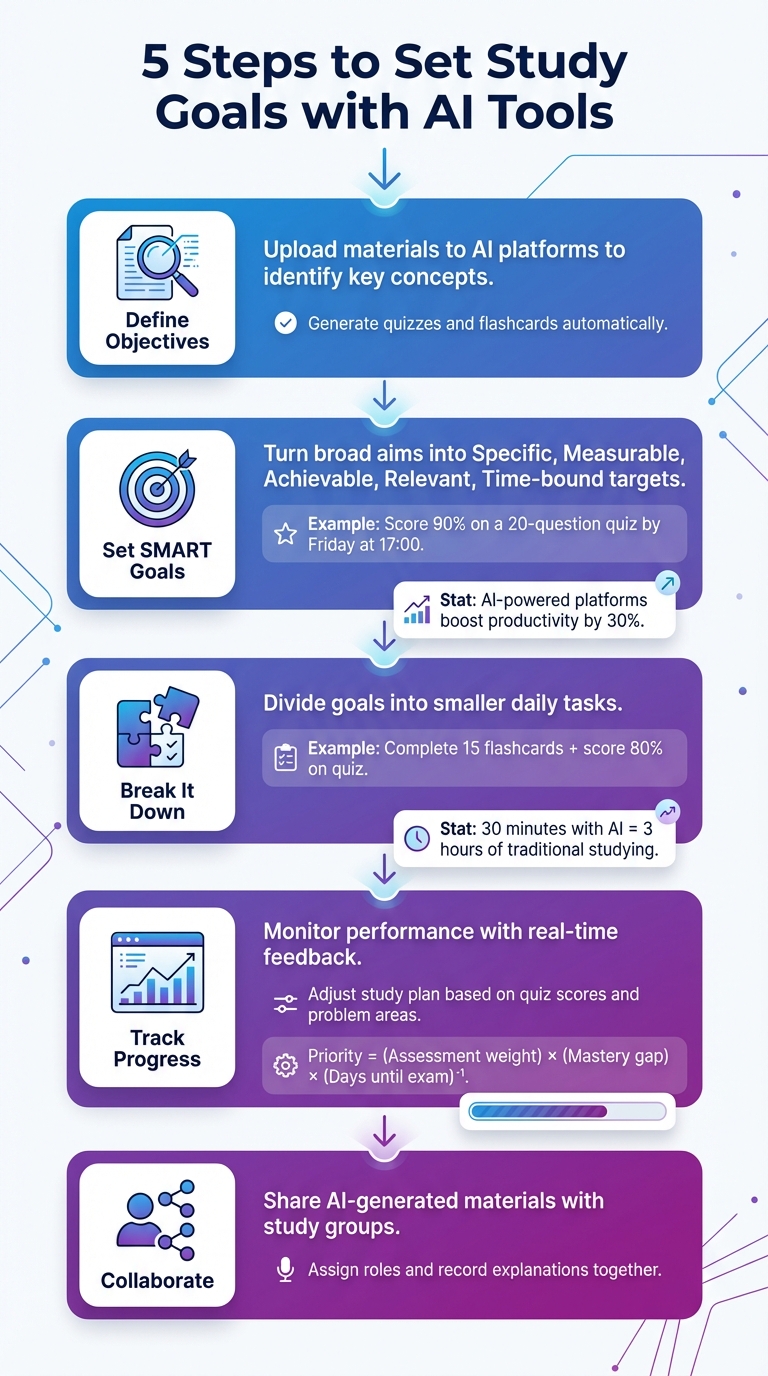
5 Steps to Set Study Goals with AI Tools
How to Study with AI: Boost Your Learning Like Never Before Creating Study Plan
Step 1: Define Your Study Objectives with AI
Figuring out what to focus on while studying can be tricky. You might spend hours poring over a textbook, only to realise you’ve been stuck on minor details while missing the bigger picture. AI tools can take the guesswork out of this process by analysing your materials and highlighting the key concepts that truly matter.
How AI Breaks Down Your Study Materials
When you upload a document or paste your lecture notes into an AI tool, it scans the content to pull out the main topics and essential concepts. It also determines which information is most relevant to your learning goals. By identifying the questions your material addresses and breaking down section headings, it helps you focus on the arguments and ideas that hold the most weight.
The AI employs a technique called "priming", which involves generating tests on topics before you even begin reading. This method flags key facts and prioritises content that reinforces memory. Studies show that testing during study sessions is far more effective for improving memory than simply re-reading, especially when there’s a gap between learning and recall. AI tools make this process seamless by pinpointing the areas you need to prioritise.
Setting Objectives with Testudy.io
Taking this analysis further, Testudy.io transforms these identified concepts into practical tools like quiz questions and flashcards. The platform supports multiple formats – text, PDFs, even screenshots via its Chrome extension – and converts them into tailored study goals. Simply upload your materials or select a topic, and the AI scans the content to determine what you need to master. It then creates quizzes and flashcards designed to reflect those priorities. This focused analysis serves as the backbone for crafting a personalised study plan.
Law student Sophie Moore shared her experience: "If Testudy existed when I started my degree, my GPA would be a lot higher. … Honestly, it saves my grades".
Another standout feature is Testudy.io’s multi-language support. It processes content in over 15 languages, including English, German, Spanish, Italian, Chinese, and Japanese, making it easy to set clear objectives no matter the original language of your materials. Once your initial quiz is ready, you can review and tag questions as A (known), B (medium), or C (hard). This tagging system helps you focus on the areas that need the most attention, ensuring that each step of your study session is purposeful and aligned with your goals.
Step 2: Turn Objectives into SMART Goals
Take your study ambitions and turn them into SMART goals to give your learning a clear direction. A vague aim like "learn biology" doesn’t tell you where to begin or how to measure success. That’s where the SMART framework comes in – helping you shape broad aspirations into goals that are Specific, Measurable, Achievable, Relevant, and Time-bound. The best part? AI tools can break down your study materials into manageable, actionable tasks with clear benchmarks for success. This structure allows AI to create prompts that guide you step by step.
Using AI Prompts to Create SMART Goals
AI tools can take your general study goals and turn them into something you can act on. For instance, instead of saying, "I want to understand the Krebs cycle", you could ask an AI tool to craft a goal like: "Score 90% on a 20-question quiz about the Krebs cycle by Friday at 17:00". This is SMART because it’s specific (focused on the Krebs cycle), measurable (90% on a quiz), achievable (a quiz with 20 questions), relevant (it fits into your curriculum), and time-bound (you have a set deadline).
Need help creating your own SMART goals? Try a prompt like: "Turn ‘learn algebra’ into a SMART goal with three 45-minute sessions per week over eight weeks". Structuring your targets this way not only makes them easier to tackle but also increases your chances of completing assignments. In fact, research shows that AI-powered platforms can boost study productivity by as much as 30%.
Building SMART Goals with Testudy.io
Testudy.io takes the hassle out of creating SMART goals. Upload a PDF or paste your lecture notes, and the platform will automatically generate quizzes and flashcards that act as measurable progress tools. For example, you could set a goal like: "Complete 50 flashcards on cellular respiration and score 85% on the follow-up quiz by Wednesday". The instant quiz feedback helps you track your progress in real time.
Feeling overwhelmed by huge study tasks? Testudy.io can break them into bite-sized chunks. For example, it can transform a dense 50-page document into smaller, digestible sections, helping you avoid burnout.
As marketing student Daniel Scott says: "Testudy is the GOAT! … it’s awesome to have an unlimited number of tests at my disposal for any course".
Step 3: Break Goals into Smaller Tasks
After defining your SMART goals, the next step is to make them more achievable by breaking them into smaller, actionable tasks. For instance, a goal like "Master organic chemistry by March" can feel overwhelming – until you divide it into daily objectives. AI tools can simplify this process by transforming study materials into quizzes and flashcards. This shift from passive reading to active recall helps pinpoint knowledge gaps and ensures more effective learning. By breaking down your goals, you create clear, measurable steps for focused study sessions.
Generating Quizzes and Flashcards
With tools like Testudy.io, you can upload study materials directly via a Chrome extension or on the platform itself. The AI quickly generates quizzes and flashcards, and since it supports multiple languages, it’s accessible to students worldwide.
Here’s an example: instead of aiming to "Read Chapter 5 on the French Revolution", you could create 15 flashcards covering essential dates, figures, and events. Then, set a specific goal like, "Complete these 15 flashcards and score at least 80% on the accompanying quiz."
Medical student Whitney Phillips shares, "Even when I don’t feel like opening books, I can just create tests and learn 90% of my material in a less boring way".
Once you’ve created your quizzes and flashcards, the next step is to incorporate them into a structured study plan.
Scheduling Your Study Tasks
Breaking your goals into smaller tasks is only the beginning – you also need to schedule them effectively. Time-boxing is a great method for this. Allocate focused 25-minute blocks to specific AI-generated tasks, such as completing a set of flashcards or tackling quiz questions. For example, plan a session like, "Tuesday, 18:00–18:25: Complete 20 flashcards on cellular respiration."
Turn vague intentions into concrete outcomes. Instead of simply saying, "Revise History", set a precise goal like, "Answer 10 AI-generated quiz questions on Section 3.2 by Thursday at 16:00." You can even use a priming technique – generate a quiz on a topic before studying it. This way, you’ll know which key facts to focus on during your reading.
This approach doesn’t just save time – users have reported that 30 minutes with Testudy.io can be as effective as 3 hours of traditional studying. In fact, it can boost productivity by up to 30%.
sbb-itb-3165b23
Step 4: Monitor Progress and Adjust Your Goals
Keeping track of your progress and fine-tuning your goals is just as important as the initial planning. AI tools like Testudy.io make this process seamless by providing real-time feedback on your performance. For example, after completing a quiz, the platform immediately identifies areas where you might be struggling. This instant feedback becomes the foundation for tracking your progress in greater detail.
Tracking Progress with AI
Testudy.io does the heavy lifting when it comes to tracking your progress. It automatically compiles data from your quizzes and flashcards, keeping tabs on metrics like the number of flashcards completed, quiz scores, and recurring problem areas. This data-driven approach helps personalise your learning journey based on your actual performance. For instance, if your quiz results show consistent gaps in certain subjects, you’ll know exactly where to focus your energy.
To make the most of this progress tracking, you can use your AI-generated quiz results to organise your revision. Assign tags to topics based on difficulty – schedule tougher subjects for immediate review and set aside easier ones for later. This way, you’re prioritising what needs your attention the most.
Adjusting Goals Based on Performance Data
Once you’ve gathered enough performance data, it’s time to revisit and refine your goals. Take a look at your weekly metrics, such as the hours you’ve spent studying or your quiz scores, and adjust accordingly. For example, if you notice your quiz scores drop during evening study sessions, consider tackling your most challenging topics earlier in the day when your energy levels are higher.
You can also apply a formula to set your priorities: Priority = (Assessment weight) × (Mastery gap) × (Days until exam)⁻¹. Let’s say organic chemistry makes up 40% of your final grade, your current quiz scores are at 50%, and you’ve got 10 days until the exam. This formula would indicate that organic chemistry should take precedence. As you improve, you can start phasing out AI hints and scaffolding to mimic real exam conditions, helping you build confidence and independence.
Step 5: Share Goals and Collaborate with Peers
Once you’ve started tracking your progress, sharing your goals with others can take your learning experience to the next level. Studying solo can sometimes feel isolating, but collaborating with classmates by sharing your AI-generated materials can make the process more engaging. Platforms like Testudy.io make this incredibly easy. After creating quizzes or flashcards from your notes, you can share them with your study group, ensuring everyone is working from the same material.
Sharing Study Materials on Testudy.io
Before sharing, take a moment to review and refine the AI-generated questions. You can edit existing ones or add new ones to ensure they’re accurate and high-quality. Once you’re happy with your set, it’s time to share it with your peers.
As Daniel Scott, a marketing student, said:
"Testudy is the GOAT! … it’s awesome to have an unlimited number of tests at my disposal for any course".
This flexibility allows you to create focused materials for specific chapters or topics and share them with your group before study sessions. Everyone can then walk into the session with a solid foundation, ready to dive deeper into the material.
Testudy.io offers options to suit different needs. The free plan lets you create up to 3 quizzes or flashcard sets with 25 AI generations, while the Term Plan, priced at £9.99 per month, provides unlimited access. Both plans make sharing simple, fostering effortless collaboration and better group study dynamics.
Working Together to Achieve Goals
Using AI-generated content doesn’t just simplify solo study – it also improves group collaboration. To make the most of your sessions, try assigning roles like questioner, summariser, or fact-checker to keep discussions on track. Once you’ve worked through shared quizzes together, take it a step further: have each group member record a short audio explanation of a tricky concept. Sharing these recordings helps everyone grasp challenging topics and identify any gaps in understanding.
Beyond the academic benefits, this collaborative approach can ease the stress of exam preparation. Sharing goals and working together can reduce feelings of panic and give you a stronger sense of control over your progress. Plus, studying as a group is often more memorable and motivating. When everyone is striving towards the same goals, the collective energy keeps you focused and driven.
Conclusion
Setting and managing study goals doesn’t have to feel overwhelming. By following a simple five-step plan – defining your objectives, setting SMART goals, breaking them into manageable tasks, tracking your progress, and working with peers – you can completely change how you approach learning. And with the help of AI tools, tasks like pulling out key concepts or creating practice questions become quick and effortless, leaving you more time to focus on what truly matters: understanding and remembering the material.
Take Testudy.io, for example. It can whip up interactive quizzes and flashcards in seconds, making active recall – a proven memory-boosting technique – easier than ever.
AI tools also adjust to your personal learning needs. Whether you’re gearing up for a new topic, analysing performance to pinpoint areas that need improvement, or sharing resources with your study group, these tools adapt to your style. This flexibility fits perfectly into your overall study plan, making the process smoother and more efficient.
As law student Sophie Moore shared, "If Testudy existed when I started my degree, my GPA would be a lot higher. Honestly, it saves my grades".
Shifting from passive reading to active testing marks a big step forward in study habits. With flexible plans designed to suit different needs, Testudy.io makes it easier to stay on top of your learning. AI-powered tools don’t just help you plan; they make your learning journey more effective and less stressful.
Why not take the first step? Try experimenting with AI-generated materials and see how they can make learning more engaging and productive.
FAQs
How do AI tools like Testudy.io identify the key concepts in study materials?
AI tools, like Testudy.io, take the materials you upload – whether it’s a textbook, lecture notes, or even a photo of a slide – and process them using advanced natural language processing (NLP). These systems break down the text, analyse its structure, and pull out key terms, phrases, and topics using methods such as keyword extraction and topic modelling.
By doing this, the AI identifies the most relevant concepts for the subject at hand. These concepts are then used to create personalised quizzes and flashcards automatically, helping you focus on what matters most. Plus, the platform supports multiple languages, making it suitable for learners with diverse needs.
How can AI help you set effective SMART study goals?
Transforming your study plans into SMART goals – Specific, Measurable, Achievable, Relevant, and Time-bound – can give your learning a clear sense of direction. Instead of setting vague targets like "study more", SMART goals help you focus on concrete milestones that are easier to track and keep you motivated.
Adding AI into the mix takes this process to a whole new level. AI can evaluate your past performance, suggest realistic goals, and break larger objectives into smaller, manageable tasks that fit your personal learning style. It can also provide real-time updates on your progress, offer insights to help you tackle challenges, and send reminders to keep you on schedule.
Take tools like Testudy, for example. This AI-powered platform creates quizzes and flashcards from any text, allowing you to directly connect your SMART goals with specific practice material. This way, your study sessions become focused, measurable, and perfectly aligned with your objectives, making it easier to track your progress and stay motivated.
How can sharing AI-generated study materials improve group study sessions?
Sharing AI-powered study materials can transform group study sessions into a more engaging and productive experience. By offering consistent, high-quality resources, these tools ensure everyone in the group has access to the same information. With AI, you can quickly generate quizzes, flashcards, or concept maps and share them instantly. This saves time and lets the group dive straight into meaningful discussions, clearing up misunderstandings and applying what they’ve learned, rather than spending time creating materials from scratch.
These tools also encourage teamwork. For instance, one person could take charge of a quiz, another could explain key terms, and someone else could create a concept map to visualise the topic. This kind of active involvement not only reinforces learning but also keeps the session lively and collaborative. Platforms like Testudy.io make this process straightforward, allowing users to create and share tailored study materials in seconds, catering to different learning preferences and even multiple languages. The end result? A more efficient, interactive study session that helps everyone grasp the material better.