

AI tools are transforming language proficiency testing by offering faster, more precise, and personalised assessments. These tools replace static exams with dynamic systems that adjust to your skill level in real time. They evaluate all language skills – reading, writing, speaking, and listening – while aligning with global standards like CEFR. Platforms like Testudy.io take it further by helping learners prepare with AI-generated quizzes and flashcards, saving time and improving retention.
Key Takeaways:
- Real-Time Testing: AI adapts questions based on your responses, delivering results in minutes.
- Interactive Features: Simulated conversations and roleplay improve practical language use.
- Global Standards: Many tools align with CEFR, ensuring results are recognised worldwide.
- Study Tools: Platforms like Testudy.io create quizzes and flashcards from any text, supporting over 20 languages.
AI-driven tools are reshaping language learning and testing, offering faster, fairer, and more engaging experiences for learners worldwide.
Assessing with AI: Tech Tools for Engaging Language Assessments
Testudy.io: AI-Powered Quiz and Flashcard Generation
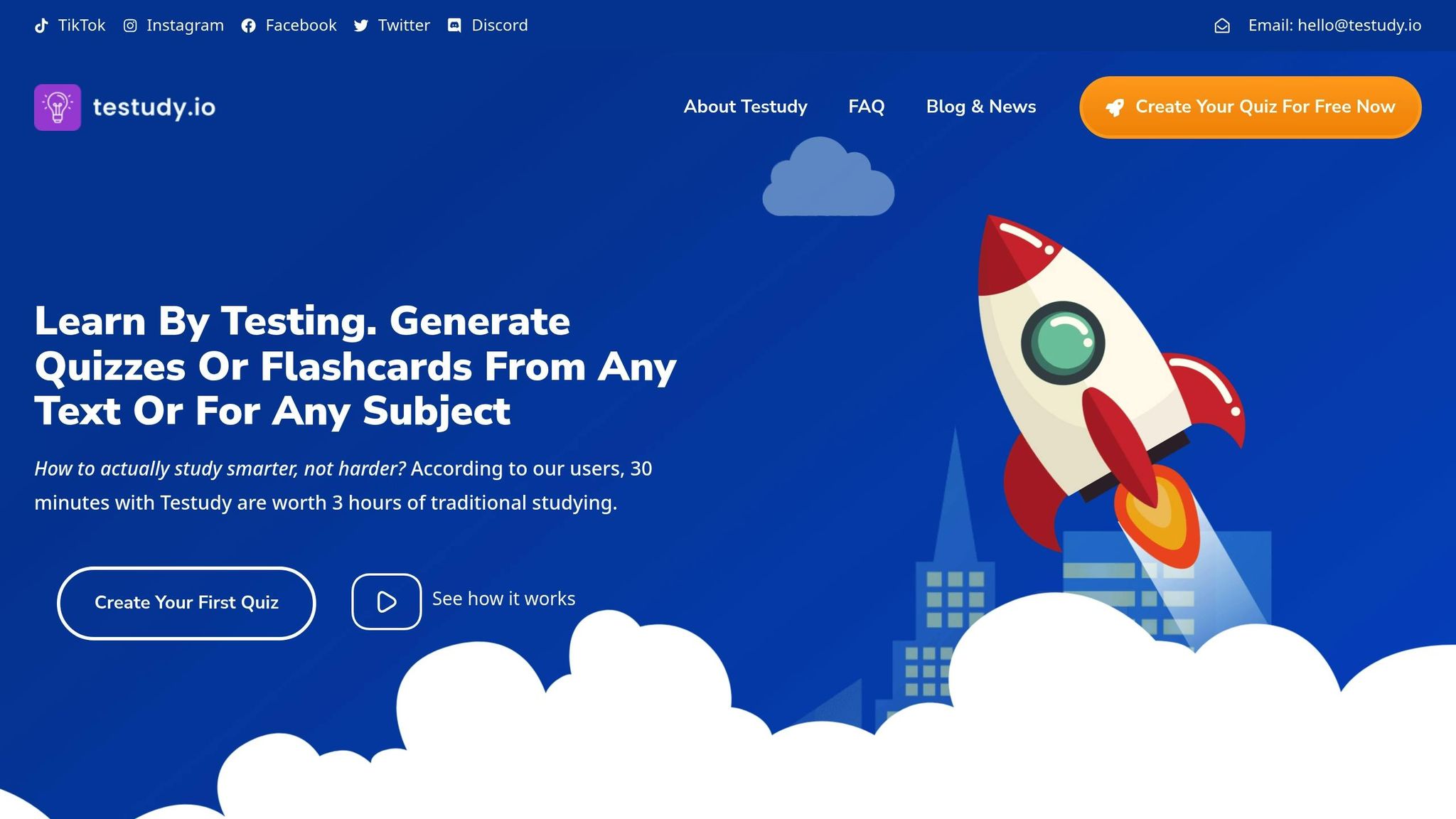
Testudy.io offers a smart, AI-driven solution for preparing for proficiency exams. The platform takes any text – whether it’s a PDF, lecture notes, or something you’ve copied and pasted – and turns it into quizzes and flashcards. With support for over 20 languages, including English, German, Spanish, Italian, Chinese, and Japanese, it’s a versatile tool for learners tackling a variety of international exams. This makes it especially useful for those preparing for language proficiency tests.
The platform uses adaptive learning technology to track your progress and adjust the difficulty of questions based on your performance. By combining active recall and spaced repetition techniques, it helps strengthen long-term memory retention. Impressively, users have found that just 30 minutes of studying with Testudy can be as effective as three hours of traditional study methods. It’s no wonder the platform enjoys a 97% satisfaction rate among students.
Main Features of Testudy.io
Testudy.io’s AI is designed to simplify studying by automatically identifying key concepts in your source material and turning them into study aids. You can edit and customise the generated questions to fit your specific exam format or personal preferences. The platform also offers a Chrome extension, allowing you to create quizzes and flashcards from online content or screenshots. This is particularly handy for pulling out difficult sections from foreign language articles or e-textbooks.
Additionally, Testudy.io supports collaborative learning by enabling users to share tests within study groups. Whitney Phillips, a medical school student, shares her experience:
"Even when I don’t feel like opening books, I can just create tests and learn 90% of my material in a less boring way".
How Testudy.io Supports Language Proficiency Preparation
For language learners, Testudy.io introduces a "priming" method: you can generate a quiz on a topic before diving into the actual material. This technique highlights key vocabulary and grammar points, helping you focus on the most important aspects during your first read-through. The platform’s adaptive feedback further pinpoints areas like grammar or vocabulary that need extra attention, allowing you to create targeted follow-up quizzes.
The Chrome extension is particularly helpful for turning challenging content from foreign language websites or online articles into study materials. Sophie Moore, a law student, praises the platform, saying:
"If Testudy existed when I started my degree, my GPA would be a lot higher. Honestly, it saves my grades".
How AI Tools Improve Language Proficiency Testing
AI has revolutionised language proficiency testing, making it faster and more efficient than ever. Today’s AI-powered platforms can evaluate key skills like reading, writing, speaking, and listening, delivering results in just minutes. What’s more, this speed doesn’t compromise accuracy. These tools rely on advanced algorithms to assess aspects such as grammar and pronunciation, offering detailed analytics that highlight specific areas for improvement. This combination of speed and precision sets the stage for the many benefits these tools bring.
Instant Feedback for Faster Learning
One of the standout features of AI-driven language assessments is the ability to provide instant feedback. Unlike traditional tests, which can take days or weeks to process, AI tools generate personalised reports immediately. These reports dive into subscores, pinpointing weaknesses in areas like vocabulary, grammatical accuracy, fluency, and pronunciation.
Interactive roleplay scenarios are another innovative feature, offering real-time feedback on interactional competence – essentially, how well learners navigate social dynamics in conversations. In virtual classrooms, AI can track a student’s speaking time and accuracy as they participate in live sessions, giving continuous insights into their performance. For instance, EduSynch’s platform has handled over 78 million questions, showcasing the scale and efficiency of instant feedback.
Customisation and Personalisation
Beyond quick feedback, AI takes personalisation to a new level through tools like Computer Adaptive Testing (CAT). This method adjusts the difficulty of questions based on a learner’s previous answers, providing a more accurate and efficient measure of their proficiency compared to traditional fixed-format tests. EF Corporate Learning explains it well: "AI simply adapts the test to accommodate the measured level of the speaker and assesses based on accuracy and comprehensibility, including in the nuanced spoken word".
Some platforms go even further, offering over 300 hours of adaptive practice material tailored to individual performance. This ensures learners focus on areas that truly challenge them, avoiding time spent on tasks that are too easy or too difficult. Advanced scoring systems add another layer of precision, offering up to 100 points of differentiation. This allows learners to track small but meaningful progress, filling in gaps that broader frameworks like the CEFR might miss. Such detailed assessments are especially crucial, as nearly 75% of employees with low English proficiency report challenges in fully participating at work.
Alignment with International Standards
AI-driven assessments don’t just offer technical advantages – they also align with globally recognised benchmarks like the CEFR. This framework provides a consistent scale, from A1 (basic user) to C2 (proficient user), for evaluating all four language skills. Modern AI platforms achieve this alignment through methods like linguistic feature-based classification, fine-tuning pre-trained large language models, and using descriptor-based prompts based on official CEFR level descriptions.
The UniversalCEFR dataset, which includes over 505,000 CEFR-labelled texts across 13 languages, highlights the extensive research underpinning these standards. By incorporating psychometric validation, AI-powered assessments ensure statistical reliability while reducing human bias. As one source observes, "With AI now a part of language assessments, English speakers can test all four language skills… without fear of human error or bias". This combination of international standardisation and AI precision ensures results are trusted by employers and educational institutions around the world.
sbb-itb-3165b23
What to Consider When Choosing an AI Tool
Picking the right AI tool for language learning can feel overwhelming, but focusing on a few key factors – language support, ease of use, and cost – can simplify the process. These elements ensure the tool aligns with your goals and fits seamlessly into your study routine.
Language Support and Skill Assessment
First, make sure the tool supports the language you’re learning and covers all the skills you need. Some platforms even cater to over 60 languages.
High-quality tools go beyond offering a single overall score. Instead, they provide detailed feedback with sub-scores for areas like fluency, grammar, vocabulary, pronunciation, and coherence. For speaking, look for tools that assess prosody, and for writing, choose ones that evaluate grammar, organisation, and relevance.
Another great feature to seek out is multi-source content input. Some tools allow you to create study materials from sources like PDFs, YouTube links, or lecture slides, helping you engage with authentic language content. There are even platforms that support generating assessments and activities in up to 39 different languages.
User-Friendly Design and Integration
Ease of use is crucial. Opt for tools with intuitive interfaces that work across devices. Features like export options (e.g., PDF or TXT) and integration with study apps can make your learning materials more accessible and adaptable.
For language learners, multimedia features are a game-changer. Tools that process YouTube links let you learn from real-world content, while extras like Text-To-Speech (TTS) and QR code integration allow instant access to quizzes, no matter the device.
Balancing Cost and Features
For budget-conscious learners, it’s all about finding the right balance between price and features. Many platforms offer free versions, so you can test their capabilities before committing financially.
When considering paid options, think about the time savings they offer. For example, AI-powered flashcard automation can save around 2 hours for every 10 hours of study. Features like instant contextual feedback and spaced repetition further optimise your learning efficiency. Free tiers are a great way to gauge a tool’s accuracy and value before making a financial investment.
Conclusion
AI-powered tools have reshaped how learners approach language test preparation. Platforms like Testudy.io provide a game-changing solution by turning texts and multimedia into personalised quizzes and flashcards in seconds, supporting over 20 languages. This ability to instantly create study materials, combined with effective learning strategies like active recall and spaced repetition, makes retaining vocabulary and grammar much easier than traditional methods.
One of the standout benefits is personalisation. Adaptive testing technology adjusts the difficulty of tasks in real time based on your responses, ensuring you’re always working at a level that challenges but doesn’t overwhelm you. AI also offers immediate, CEFR-aligned scoring, helping you pinpoint areas for improvement and adjust your study plan right away. Joy Karina from Berlitz highlights the practical impact:
"Not only has it helped to ensure the integrity of our online exams, but it has also saved our teachers and administrators countless hours of time. Instead of manually proctoring exams, they can now focus on other tasks and responsibilities."
Beyond just testing, modern AI tools are advancing how interactional competence is measured. By simulating real-world conversations, these tools prepare learners for practical social interactions, moving far beyond static multiple-choice questions. Sophie Wodzak from Duolingo provides insight into this innovation:
"The DET’s latest item uses generative AI to [simulate real‑time conversations], allowing us to test language skills like never before – this is just one of the ways we use new technology to enhance how we measure language ability."
Whether you’re exploring Testudy.io’s free plan or considering an upgrade, the most important factor is finding a tool that suits your study goals. Features like comprehensive language support, intuitive design, and alignment with international standards like the CEFR make a significant difference. With over 1 million users globally, these tools have already made test preparation more efficient and accessible, paving the way for even greater advancements in language learning.
Looking forward, the integration of AI in language education promises to complement traditional instruction with tools that adapt to your learning pace, provide instant feedback, and simulate real-life communication scenarios. For students tackling high-stakes exams, this technology offers a practical edge that was once unimaginable.
FAQs
How does AI enhance the reliability of language proficiency tests?
AI improves the accuracy of language proficiency tests by using advanced machine learning to evaluate various skills, including speaking, listening, grammar, and interaction abilities. This approach ensures assessments are consistent, impartial, and aligned with established standards like the CEFR.
By identifying patterns and delivering in-depth feedback, AI-powered tools remove human error and bias, providing learners with more accurate and tailored evaluations.
How can Testudy.io help with language proficiency test preparation?
Testudy.io takes the stress out of language test prep by offering AI-driven tools that let you craft personalised quizzes and flashcards from any text or topic. With support for more than 20 languages, it enables you to zero in on areas like vocabulary, grammar, and comprehension – perfectly adjusted to match your learning pace.
Its customisable options let you practise essential skills – reading, writing, listening, and speaking – using materials that closely resemble actual exam formats. This makes it a great choice for preparing for tests like IELTS or TOEFL. The user-friendly interface and option to share resources make Testudy.io an adaptable and interactive study tool, helping you prepare more effectively and approach your test with confidence.
How does Testudy.io’s adaptive learning technology improve study efficiency?
Testudy.io uses smart learning technology to make studying languages more efficient. By customising quizzes and flashcards to suit your current skill level, it ensures you concentrate on the areas where you need the most improvement. This eliminates unnecessary repetition and streamlines your learning experience.
The platform adjusts the difficulty of questions in real time based on your performance. This keeps you challenged without feeling overwhelmed, allowing you to make steady progress. Plus, instant feedback highlights what you’re doing well and where you can improve, making it easier to focus your revision and study smarter.
Thanks to its AI-powered design, Testudy.io tailors each study session to your needs, saving you time and helping you build language skills more effectively.


